
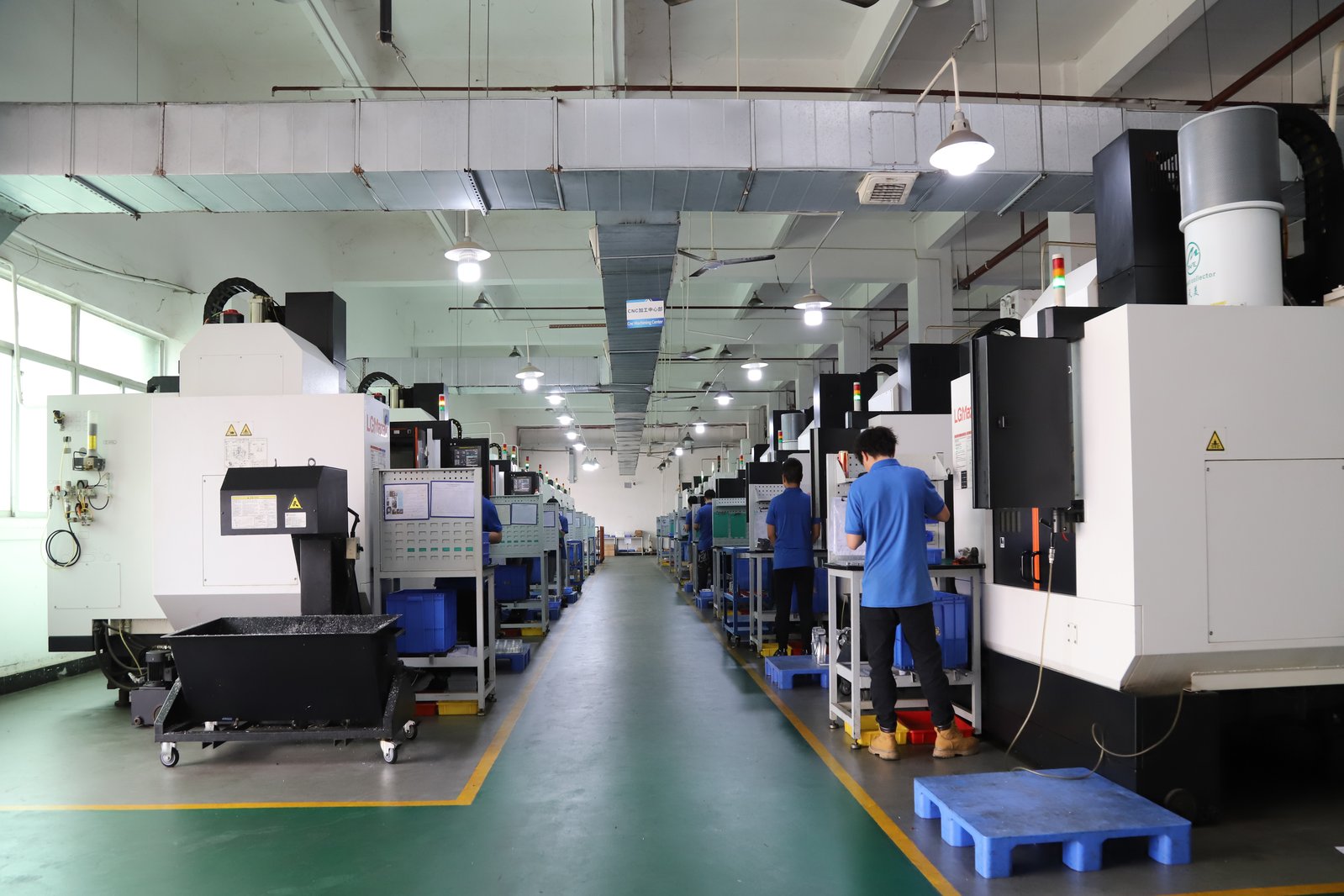
Every part number that crosses from a China machining factory to your door carries a schedule, and the schedule is built from the same map as the price: the process route. A simple bracket needs a few operations and ships fast; the same part with a heat treatment step, a ground seat, a finish, and a CMM report needs every one of those operations scheduled, executed, and verified. Buyers who separate the lead-time conversation from the process conversation are planning half the problem, because the route is the schedule. This guide walks through what drives China machining lead times and how to plan around them.
Why is a China machining lead time a sum, not a number?
A lead time from a machining factory is not a single promise; it is the sum of every step between your drawing and your dock. Material must be procured to the grade on the drawing, and common grades are in stock while exotic alloys take days to source. The machining itself takes the machine hours the route demands. Secondary operations — threads, grinding, heat treatment, plating — each add their own schedule, and where they run on a partner's line the hand-off adds days. First article verification, production inspection, and the lot paperwork all sit between the last operation and the shipping carton.
Holding that sum in view changes how you read a quote. A factory that quotes a date with the route behind it is quoting a schedule you can plan around; a factory that quotes a flat number with no process is quoting a hope. When a date slips, it never slips all at once — it slips one step at a time, and the buyer who knows the route can see which step is late and what it means for the rest of the program. The route is the schedule, and the buyer who reads the route reads the schedule.
Which process steps add the most days?
On a machined part, the days stack in a predictable order. The first-article and prove-out step is fixed regardless of quantity, which is why a prototype carries a schedule out of proportion to its size. Machining time itself is usually the smallest part of the calendar — a run of hundreds of parts moves in days once the machine is set. The largest drivers are the steps around the machining: material procurement for exotic grades, heat treatment with its cycle and its queue, finishing lines with their own lead times, and verification, which on precision work adds CMM time and report generation to the calendar.
When you ask a factory for a lead time, ask for the breakdown, not just the total. Which material is in stock and which must be ordered? Is the heat treatment in-house or on a partner's line, and how long is that queue? Is the finishing scheduled with the machining or after it? Where the answer is a named step with a named duration, you have a schedule; where it is a total with a shrug, you have a guess wearing a date. A factory that itemizes its calendar is a factory that manages it.
How does the material choice move the calendar?
Material moves the schedule in two ways. First, availability: 6061 aluminum and the common steel and stainless grades sit in stock at most Chinese factories, and the cutting can start the day the order is confirmed; exotic alloys — titanium, Inconel, special bar stock — have to be procured, and procurement is days, not hours. Second, machinability: a free-machining grade cuts fast and holds its time, while a work-hardening or tough alloy runs slower, wears tools, and makes the machining step longer and less predictable. Both effects belong in the schedule before the quote.
The buyer's planning rule is to name the grade and the condition on the drawing and ask the factory which are in stock. A part that can be specified in a stocked grade starts its clock at confirmation; a part locked to an exotic alloy starts its clock when the material lands. And when the material must be verified against its certificate at receiving, that verification adds a step to the calendar as well — one that protects the whole run but costs a day, and should be planned for rather than discovered.
The verification step at receiving also decides how cleanly the rest of the route runs. A factory that quarantines unverified stock and clears it with positive identification before cutting protects the run from a substituted-alloy surprise, but that discipline occupies a day on the front of the calendar. Weigh it as a planning item rather than an invisible cost: the day spent verifying material at the door is cheaper than the weeks spent discovering a wrong alloy after machining, and the factory that schedules the check is the factory whose route you can trust.
How do heat treatment and finishing extend the schedule?
Heat treatment and surface finishing are where machining lead times quietly grow, because they are processes with cycles and queues of their own. A part that is machined, heat treated, and then finished on its critical features carries three calendars: the machining, the treatment with its furnace cycle and its queue at the treatment house, and the return to the floor for the finish operations. Where treatment and finishing run on partners' lines, the hand-offs add transport and scheduling days that no single machine-hour estimate captures.
The planning answer is to treat the treatment as a named step with a named duration and to confirm who owns it. A full-service factory that runs heat treatment and finishing in-house, or coordinates them on a fixed schedule with named partners, can give you a route with dates; a supplier that treats them as an afterthought will discover the delay with you, on your schedule. When you quote a part with treatment, ask for the calendar from machining start to finished, treated, and verified lot, and plan the treatment as the milestone it is.
How does capacity decide whether your date is real?
A machining factory's capacity is a finite set of spindles, each of which runs one job at a time, and your order's date depends on where it sits in that queue. A job scheduled into an open slot ships when the route says it will; a job that arrives when the floor is full waits for a spindle, and the wait is the difference between the factory's promise and your reality. This is why capacity planning is the cheapest lead-time insurance a buyer can buy: share your annual volume and your ramp early, and ask the factory to reserve the machine time your program needs.
Ask the factory directly how its floor is loaded when you place an order, and what the current queue is on the machine type your part needs. A factory that answers with the load and the slot is running a visible schedule; one that answers with reassurance is running a hope. And when a date matters, ask what the factory will do to hold it — priority on the relevant machine, material ordered in advance, treatment pre-booked — because the buyer who asks for the mechanism is the buyer who gets the date.
Seasonality deserves a place in the same planning. Chinese factories slow around the national holidays, when the floor closes and the schedule resets, and ramp hard in the weeks after; buyers who plan shipments across those windows carry the risk of a two-week pause in the middle of a program. Ask the factory how the holiday calendar lands against your dates, and place orders that clear the pause rather than crossing it, because a schedule that ignores the factory's calendar is a schedule that will be rewritten by it.
How does verification and first article time land on the calendar?
Precision work carries a verification step that standard machining does not, and it belongs on the calendar. The first article must be machined, measured against the drawing on the right instruments, reviewed, and approved before the production run begins, which on a China order is a scheduling gate in its own right. Production lots then carry inspection time, and the CMM routines, surface measurements, and lot paperwork all sit between the last operation and the shipping carton. On tight-tolerance parts, verification is not overhead; it is a step with a duration, exactly like machining.
The planning rule is to make the first article a named milestone with its own date, and to review it the day it arrives rather than the day before production is due. Agree in the PO how long the factory holds after shipping the first article before the run starts, and what triggers a re-run of the FAI. A factory that schedules its verification the way it schedules its machining is a factory whose quality system runs on the calendar, and that is the only kind whose dates survive contact with a CMM.
One practical accelerator is to run the prototype on the production route. When the first article is cut on the same machine type, the same fixture, and the same program that production will use, its approval clears the process rather than just the part, and the production run can start the day after the FAI is accepted instead of after a separate prove-out. Ask the factory whether your prototype is production-routed, because a prototype made on a different machine tells you the design works but tells the schedule nothing about the production setup.
How does freight and the Incoterm affect the total time?
The factory's production date is not your receipt date, and the gap between them belongs to the Incoterm. Air freight moves a machined part from a Chinese factory to most world destinations in days; sea freight takes weeks. The Incoterm decides who owns that leg: on EXW or FOB terms, the freight is your step to arrange; on DDP terms, the factory or its forwarder owns it and quotes it as part of the delivered schedule. A buyer planning a China program should count the freight leg with the same care as the machining, because the only date that matters is the one parts arrive.
Ask every factory for the same Incoterm and ask what the freight schedule is under that term, because a factory that ships weekly and one that ships on a monthly consolidation deliver the same part weeks apart. And plan the border: customs, the port or airport, and the inland leg to your plant all add days that belong to your schedule, not the factory's. A total landed calendar — factory production date, freight, and border — is the number to plan around, and the buyer who builds it in writing is the buyer whose line keeps running.
Packaging and documentation belong on the same calendar as the freight. The lot records, certificates, and inspection reports that aerospace and medical buyers require are assembled after the final inspection, and an order held at the dock for its paperwork is an order that arrived late for no machining reason at all. Agree the document package in the PO, confirm it ships with the parts rather than after them, and ask for the customs entry documents ahead of the freight booking, because a complete file moves across the border on schedule while an incomplete one waits in it.
How do you build a China machining schedule that holds?
Build the schedule the way the route is built — step by step, with the assumptions named.
- Get the route in writing. Ask the factory to itemize the calendar: material procurement, machining, treatments, finishing, first article, production inspection, and packing — with dates or durations on each step.
- Share your volume and ramp early. Give the factory your annual quantity and target dates and ask for capacity to be reserved, so your runs sit in the schedule rather than in the queue.
- Add the freight leg on the same Incoterm as the quote. Air or sea, with the border days, so the landed calendar — not the factory date — is the one your line plans around.
Keep the closing rule in front of you: read a lead time as a route with its assumptions stated, not a headline, and the China machining schedule you build will hold across the drawing changes, quantity shifts, and reorders that real sourcing always brings. The factory that shows you the route is the factory that can hold the date.
Frequently Asked Questions
How long do China machining factory lead times actually run?
Typical production lead times run roughly 3 to 7 days for simple machined parts and around 30 days or more for complex parts with treatments and finishing, plus freight to your door. The real number comes from the process route — every operation, treatment, and verification step adds days.
What drives a China machining lead time the most?
The process route and its hand-offs: machining time, secondary operations, heat treatment and finishing with their partner schedules, first article verification, and freight. A factory that runs the chain in-house shortens the schedule by removing the hand-offs between vendors.
Can a China machining factory shorten a lead time?
Yes, when the bottleneck is real and named. Options include reserving capacity for your program, ordering material early, running prototypes on the production route, and splitting the lot for partial shipment. A factory that can name what it will do to hit your date is one you can plan around.
How does freight affect China machining lead times?
Freight adds days that belong to the Incoterm, not the factory. Air freight moves in days; sea freight in weeks. The factory's production date and the Incoterm decide who owns the freight leg, so plan the total with both in view.
When should I reserve capacity with a China machining factory?
Share your annual volume and ramp early and ask the factory to reserve capacity, because a production run scheduled into an open slot ships faster than one that waits for a free spindle. Capacity planning is the cheapest lead-time insurance you can buy.
How do I know a promised China lead time is real?
Ask what the date assumes: the material procurement, the machine availability, the treatment and finishing steps, and the verification. A factory that states the route behind the date is quoting a schedule; one that promises a number with no process is quoting a hope.
Need a China machining date you can plan around?
Send the drawing, the annual volume, and the target date through the contact page — the review will come back with the route behind the date, the capacity plan, and the Incoterm, all in writing.